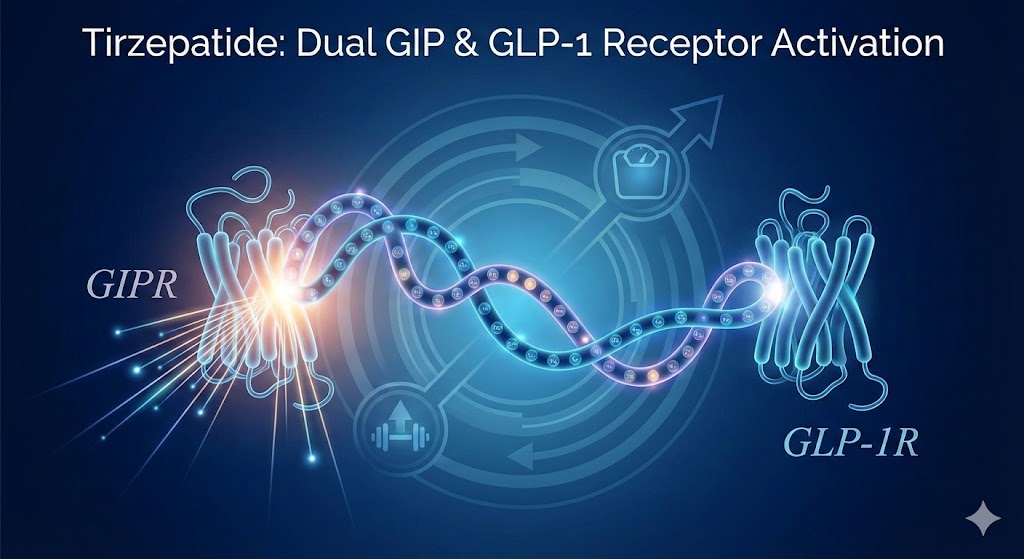
Tirzepatide represents a significant evolution in the field of incretin-based peptide research. Unlike earlier generations of peptide analogues that targeted a single receptor, Tirzepatide is a dual glucose-dependent insulinotropic polypeptide (GIP) and glucagon-like peptide-1 (GLP-1) receptor agonist.
This synthetic peptide has garnered intense interest in the biotechnology community for its unique, "imbalanced" mechanism of action and its structural modifications that allow for prolonged half-life in research settings.
This article explores the biochemical properties, receptor affinity profile, and synergistic mechanisms of Tirzepatide as observed in preclinical and in vitro models.
The "Twincretin" Mechanism: An Imbalanced Dual Agonist
Tirzepatide acts as a single molecule that binds to and activates both the GIP and GLP-1 receptors. However, it does not activate them equally. Research characterizes Tirzepatide as an imbalanced dual agonist:
- GIP Receptor (GIPR): Tirzepatide exhibits high affinity for the GIP receptor, comparable to that of native GIP.
- GLP-1 Receptor (GLP-1R): It binds to the GLP-1 receptor with significantly lower affinity (approximately 5-fold weaker) compared to native GLP-1.
This specific ratio—favoring GIP receptor occupancy—is believed to be central to its distinctive pharmacodynamic profile. Furthermore, studies suggest that Tirzepatide functions as a biased agonist at the GLP-1 receptor. It preferentially activates the cAMP signaling pathway while recruiting less β-arrestin compared to selective GLP-1 agonists. In cellular models, reduced β-arrestin recruitment correlates with minimized receptor internalization and desensitization, potentially allowing for sustained signaling efficacy over time.
Structural Biochemistry and Peptide Engineering
Tirzepatide is a linear peptide comprising 39 amino acids. Its sequence is primarily based on the native GIP sequence, with specific amino acid substitutions to introduce GLP-1 receptor activity.
To enhance stability and duration of action in physiological environments, the peptide structure includes a critical modification: a C20 fatty diacid moiety attached via a linker. This lipid chain facilitates non-covalent binding to albumin (plasma protein binding). In research models, this albumin binding serves two primary functions:
- Protection from Degradation: It shields the peptide from rapid enzymatic breakdown by dipeptidyl peptidase-4 (DPP-4).
- Extended Half-Life: It slows renal clearance, allowing for prolonged circulation times in animal models compared to native incretins, which typically have half-lives measured in minutes.
The Role of GIP Receptor Activation in Metabolism
While the effects of GLP-1 receptor agonism (satiety signaling, slowed gastric emptying, glucose-dependent insulin secretion) are well-documented in scientific literature, the role of GIP receptor agonism is more complex and a subject of ongoing investigation.
Historically, GIP was known to stimulate insulin secretion but was thought to be obesogenic (fat-promoting) in certain contexts. However, the application of Tirzepatide in research models has challenged this view. Current hypotheses regarding GIP agonism in this dual-peptide context include:
- Adipose Tissue Modulation: GIP receptors are abundant in adipose tissue. Activation may improve lipid buffering capacity and insulin sensitivity in adipocytes, potentially reducing ectopic fat deposition (fat storage in the liver or muscle).
- Central Nervous System (CNS) Effects: GIP receptors are located in key areas of the brain, including the hypothalamus. Preclinical data suggests that when combined with GLP-1 signals, GIP receptor activation may potentiate anorectic (appetite-suppressing) pathways, though the precise neural circuits remain under study.
Synergistic Effects: GIP + GLP-1 vs. Single Agonists
The primary research interest in Tirzepatide lies in the synergy between the two receptor pathways. Comparative studies in murine and non-human primate models have consistently demonstrated that dual agonism yields superior outcomes in metabolic markers compared to selective GLP-1 receptor agonists alone.
Key findings in preclinical literature include:
- Enhanced Glycemic Control: The combined insulinotropic effects of GIP and GLP-1 stimulation lead to more robust glucose handling in hyperglycemic conditions.
- Weight Loss Efficacy: In diet-induced obese (DIO) mice, Tirzepatide administration resulted in significantly greater weight reduction than equimolar doses of Semaglutide (a selective GLP-1 agonist). This suggests that the GIP component contributes an additive or synergistic metabolic benefit beyond what is achievable via the GLP-1 pathway alone.
Future Directions: From Dual to Triple Agonists
The success of the dual-agonist concept in laboratory settings has catalyzed the development of "next-generation" peptides. Researchers are now investigating triple agonists (such as Retatrutide) that target GIP, GLP-1, and Glucagon receptors simultaneously.
Tirzepatide remains the benchmark for multi-receptor peptide research, serving as the foundational model for understanding how complex receptor interplay can be leveraged to modulate metabolic homeostasis.
Summary of Key Research Characteristics
| Feature | Description |
|---|---|
| Peptide Type | Synthetic dual agonist (39 amino acids) |
| Targets | GIP Receptor (Agonist) & GLP-1 Receptor (Agonist) |
| Affinity Profile | Imbalanced: High affinity for GIPR, lower for GLP-1R |
| Half-Life Modification | C20 fatty diacid moiety for albumin binding |
| Primary Research Utility | Investigation of metabolic synergy, lipid handling, and insulin signaling |
Related Research Models
Explore other peptide research topics currently under investigation: