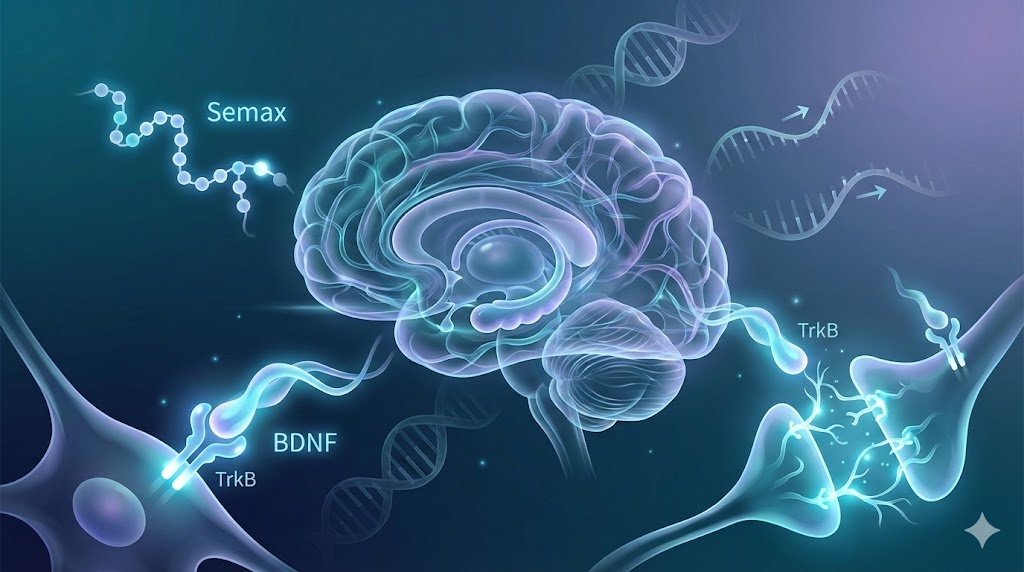
Introduction to Semax Peptide (ACTH(4-7) Pro-Gly-Pro)
Semax is a synthetic heptapeptide with the sequence Met-Glu-His-Phe-Pro-Gly-Pro. It acts as an analog of the adrenocorticotropic hormone (ACTH), specifically the ACTH(4-10) fragment. Unlike the full-length hormone, Semax has been modified to remove hormonal activity while retaining and enhancing its neurotrophic and regulatory properties. The inclusion of the Pro-Gly-Pro (PGP) tripeptide at the C-terminus significantly increases its stability against enzymatic degradation, a common challenge in peptide research.
In the field of neurobiology, Semax has garnered significant attention for its potential to modulate neurotrophic factors. Research has focused heavily on its interaction with Brain-Derived Neurotrophic Factor (BDNF), a critical protein involved in neuroplasticity, neuronal survival, and synaptic function. This article explores the existing scientific literature regarding Semax, its influence on BDNF expression, and its investigation in preclinical models of cognitive function and neuroprotection.
Mechanisms of Action: The BDNF Pathway
The primary area of interest for researchers investigating Semax is its ability to influence the expression of neurotrophins. BDNF is essential for the maintenance of healthy neurons and the regulation of synaptic plasticity—the ability of synapses to strengthen or weaken over time, which is foundational to learning and memory.
Upregulation of BDNF mRNA and Protein
Scientific studies conducted on rodent models have demonstrated that Semax administration may lead to a rapid increase in BDNF levels. Research indicates that this upregulation occurs at both the transcriptional (mRNA) and translational (protein) levels.
- Hippocampal Expression: The hippocampus, a brain region integral to memory formation, appears to be a primary site of action. Preclinical data suggests that Semax can induce a multi-fold increase in BDNF mRNA expression in the hippocampus within hours of administration.
- Basal Forebrain: Studies have also observed increased BDNF protein levels in the basal forebrain, a region associated with cholinergic function and attention.
TrkB Receptor Signaling
BDNF exerts its biological effects primarily by binding to the Tropomyosin receptor kinase B (TrkB). The interaction between Semax and the BDNF pathway is not limited to the ligand itself; research suggests that Semax may also influence the expression of TrkB receptors. By potentially upregulating both the growth factor (BDNF) and its receptor (TrkB), Semax is hypothesized to amplify neurotrophic signaling. This "dual-action" mechanism is a subject of ongoing investigation to understand how it might support neuronal resilience under experimental conditions of stress or injury.
Semax in Preclinical Models of Cognitive Function
The relationship between Semax and cognitive processes has been explored through various animal models. These studies aim to understand how the modulation of BDNF and other neurochemical systems translates to functional outcomes in a controlled laboratory setting.
Memory and Learning Protocols
In standard behavioral assays, such as active avoidance tests and maze navigation tasks, Semax has been investigated for its effects on memory acquisition and retention.
- Acquisition Efficiency: Rodent studies have reported that subjects treated with Semax often demonstrate improved efficiency in learning new tasks compared to controls. This is frequently correlated with the observed spikes in hippocampal BDNF.
- Memory Consolidation: Researchers investigate whether the peptide influences the consolidation phase of memory storage. The data suggests that Semax may modulate the molecular machinery required to convert short-term memory into long-term storage, a process heavily dependent on protein synthesis and synaptic remodeling.
Neurotransmitter Modulation
Beyond BDNF, Semax has been observed to modulate the metabolism of key neurotransmitters, including dopamine and serotonin. Experimental evidence indicates that Semax acts on the melanocortin receptors (specifically MC4 and MC5) and may influence the striatal release of dopamine. This modulation is of particular interest to researchers studying conditions characterized by dopaminergic dysfunction and deficits in executive function.
Neuroprotective Properties and Oxidative Stress
A significant portion of Semax research focuses on its potential neuroprotective utility. "Neuroprotection" in this context refers to the preservation of neuronal structure and function in the presence of cellular stress.
Ischemia and Hypoxia Models
In experimental models of cerebral ischemia (restricted blood flow to the brain) and hypoxia, Semax has been evaluated for its ability to reduce infarct volume and preserve tissue viability.
- Gene Expression Profiles: Transcriptomic analyses in ischemic rat models have shown that Semax may normalize the expression of genes related to the immune response and aascular system. This includes the downregulation of pro-inflammatory cytokines and the upregulation of genes involved in vascular remodeling.
- Mitochondrial Function: Emerging research suggests that Semax may help maintain mitochondrial stability during oxidative stress, preventing the cascade of events that leads to apoptotic cell death.
Modulation of Oxidative Pathways
Oxidative stress is a hallmark of cellular aging and neurodegeneration. In vitro studies using neuronal cell cultures have investigated Semax's ability to mitigate oxidative damage. The peptide is hypothesized to influence the activity of antioxidant enzymes, thereby reducing the accumulation of reactive oxygen species (ROS). This antioxidant capacity, combined with BDNF upregulation, presents a multifaceted profile for researchers studying neurodegenerative pathology.
Future Research Directions in Peptide Science
The scientific characterization of Semax is ongoing, with several avenues remaining open for exploration by the global research community.
- Long-term BDNF Dynamics: While acute effects on BDNF are well-documented, long-term studies are needed to understand the sustainability of this upregulation and its effects on synaptic density over time.
- Interaction with Amyloid Proteins: Recent in vitro data has suggested that Semax may interact with copper ions to inhibit the aggregation of amyloid-beta, a protein implicated in Alzheimer’s pathology. This metal-binding property warrants further investigation in biophysical models.
- Comparative Peptide Studies: Researchers are increasingly interested in comparing the efficacy of Semax with other ACTH analogs and BDNF mimetics to establish structure-activity relationships (SAR) that could guide future peptide design.
Conclusion
Semax represents a significant subject of interest in biotechnology due to its unique identity as a stable ACTH analog with potent neurotrophic effects. The body of preclinical evidence suggests that its mechanism of action is deeply intertwined with the expression of BDNF and the modulation of the TrkB signaling pathway. By influencing these critical systems, alongside dopaminergic and serotonergic networks, Semax has demonstrated potential in animal models regarding cognitive enhancement and neuroprotection. As research continues, Semax remains a valuable tool for investigating the molecular underpinnings of neuroplasticity and brain health.