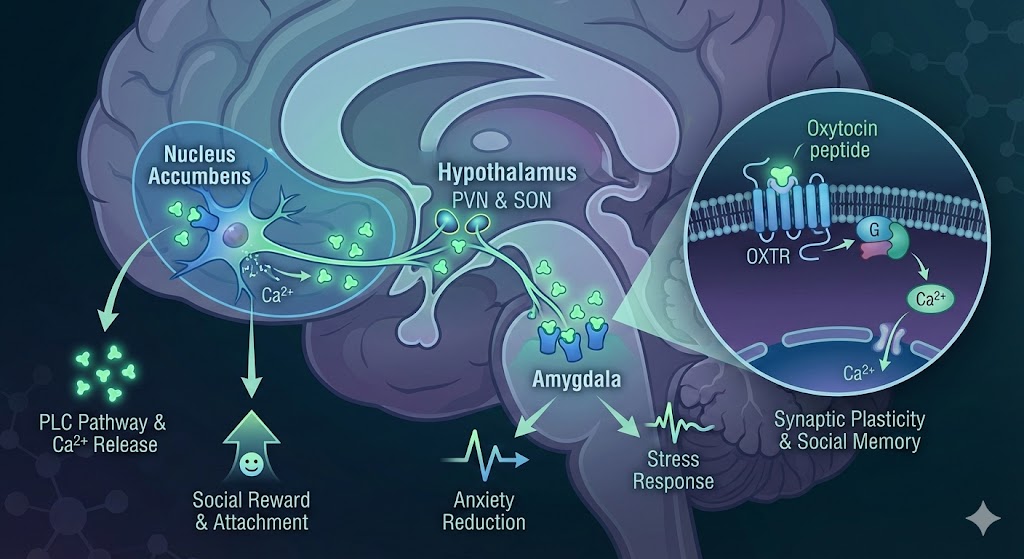
In the field of behavioral endocrinology and neurobiology, few molecules have garnered as much investigative interest as oxytocin. While often colloquially simplified in popular media, the actual pharmacological and physiological role of this nonapeptide is a complex subject of ongoing study. For researchers in biotechnology, understanding the intricate pathways of oxytocin and social bonding is critical for mapping the neurochemical basis of mammalian behavior.
Oxytocin acts as both a peripheral hormone and a central neurotransmitter. Its synthesis primarily occurs in the paraventricular (PVN) and supraoptic (SON) nuclei of the hypothalamus. From a research perspective, investigating how this peptide modulates neural circuits offers profound insights into social cognition, anxiety regulation, and inter-species bonding mechanisms.
At SPARX BIOTECH PEPTIDE, we recognize that precise, high-purity research materials are essential for elucidating these subtle signaling cascades. This article explores the current scientific understanding of oxytocin’s role in neurotransmission and social behavior models.
The Biochemistry of the Nonapeptide
To understand the functional impact of oxytocin, one must first examine its structural properties. It is a cyclic nonapeptide (nine amino acids) with a disulfide bridge between cysteine residues at positions 1 and 6. This structure is highly conserved across placental mammals, suggesting its evolutionary importance.
Synthesis and Release
Research indicates that oxytocin is synthesized as a larger precursor molecule within the magnocellular neurons of the hypothalamus. It is then packaged into vesicles and transported down axons to the posterior pituitary for systemic release. However, for social bonding and behavioral research, the focus is often on the parvocellular neurons that project centrally to various brain regions, including:
- The Amygdala: Associated with fear and emotional processing.
- The Nucleus Accumbens: Central to reward and reinforcement circuitry.
- The Hippocampus: Critical for social memory formation.
The Oxytocin Receptor (OXTR) Pathway
The physiological effects of oxytocin are mediated through the specific oxytocin receptor (OXTR), a G-protein-coupled receptor (GPCR). When researchers investigate neuropeptide signaling, the density and distribution of OXTRs are often the primary variables of interest.
Signal Transduction
Upon binding, the OXTR typically couples with Gq/11 proteins. This interaction triggers the phospholipase C (PLC) pathway, leading to the generation of inositol trisphosphate (IP3) and diacylglycerol (DAG). The subsequent release of intracellular calcium (Ca2+) is a critical step in neuronal excitability and gene transcription.
Scientific literature suggests that variations in OXTR gene expression may correlate with variations in social behavior phenotypes. In animal models, manipulating this pathway allows researchers to observe changes in social recognition and affiliation, providing a window into the molecular basis of sociality.
Mechanisms of Social Attachment and Bonding
The link between oxytocin and social bonding has been extensively mapped through comparative studies of model organisms. Perhaps the most famous examples in scientific literature involve the genus Microtus (voles).
The Prairie Vole vs. Montane Vole Models
Research comparing the monogamous prairie vole with the promiscuous montane vole has been pivotal. Studies have demonstrated that while both species produce oxytocin, the distribution of OXTRs differs significantly.
- Prairie Voles: Exhibit high densities of OXTRs in the nucleus accumbens and prelimbic cortex—areas associated with reward. This suggests that for these animals, social bonding is reinforced via the brain's reward system.
- Montane Voles: Show different receptor distribution patterns, correlating with their lack of social pair-bonding behavior.
For biotechnologists, these models underscore the importance of receptor mapping. It is not merely the presence of the peptide that dictates behavior, but the neural architecture available to receive the signal.
Maternal Behavior and Offspring Bonding
Beyond pair bonding, oxytocin is investigated for its role in maternal behaviors. Preclinical research suggests that central administration of oxytocin in virgin female rats can induce maternal-like behaviors, such as nest building and pup retrieval. This implicates the peptide in the "priming" of neural circuits necessary for caregiving.
Oxytocin and the Regulation of Stress
Another significant area of research involves the interaction between oxytocin and the Hypothalamic-Pituitary-Adrenal (HPA) axis. The HPA axis is the body's primary stress response system.
Dampening the Stress Response
Current investigations propose that oxytocin may function as an anxiolytic agent in specific research settings. By inhibiting the activity of the amygdala and suppressing the release of adrenocorticotropic hormone (ACTH) and cortisol, oxytocin may facilitate social interaction by reducing the "flight or fight" response.
This interaction is complex and context-dependent. In some research scenarios, oxytocin has been observed to increase social salience—meaning it heightens awareness of social cues, whether positive or negative. This nuance is a critical area of study for researchers looking to understand conditions characterized by social withdrawal or hyper-vigilance.
Research Frontiers: Neuroplasticity and Social Cognition
As the field advances, the focus is shifting toward neuroplasticity—the brain's ability to reorganize itself by forming new neural connections.
Long-Term Potentiation (LTP)
Studies in the hippocampus suggest that oxytocin may influence long-term potentiation, a mechanism thought to underlie learning and memory. By modulating synaptic transmission, oxytocin could play a role in how social memories are encoded and retrieved. This is particularly relevant for research into social recognition memory, where an organism must distinguish between familiar conspecifics and strangers.
Investigating Social Deficits
While strictly limiting discussion to research models, there is significant scientific interest in using oxytocin to study biological models of social deficit disorders. By observing how oxytocin administration affects social approach behavior in knockout mice or other genetic models, researchers aim to uncover the underlying pathophysiology of social impairment.
The Importance of Peptide Purity in Research
In sophisticated neurobiological studies, the quality of the reagent is paramount. Variations in peptide purity, stability, or solubility can introduce significant noise into experimental data, leading to irreproducible results.
SPARX BIOTECH PEPTIDE provides research-grade peptides synthesized to exacting standards. Whether investigating OXTR pathways in vitro or behavioral modulation in vivo, utilizing high-purity oxytocin ensures that observed effects are attributable to the peptide itself, rather than contaminants or degradation products.