Primary Keyword: Nicotinamide Riboside NAD+ synthesis
Secondary Keywords: NAD+ salvage pathway neurons, mitochondrial function in neurons, neuroprotective mechanisms of NAD+, Sirtuin activation research, Nicotinamide Riboside Kinase (NRK)
Introduction: The Metabolic Demand of Neurons
Neurons are among the most metabolically active cells in biological systems. Maintaining ionic gradients, neurotransmission, and synaptic plasticity requires a continuous and substantial supply of adenosine triphosphate (ATP). Central to this bioenergetic demand is Nicotinamide Adenine Dinucleotide (NAD+), a critical coenzyme found in all living cells.
In recent years, the scientific community has focused intensely on how neurons maintain their NAD+ pools, particularly given that NAD+ levels are known to decline with cellular aging. Research into precursors such as Nicotinamide Riboside (NR) has elucidated key pathways by which neurons synthesize NAD+, offering insights into cellular resilience and metabolic efficiency.
This article explores the biochemical mechanisms of Nicotinamide Riboside NAD+ synthesis in neuronal environments, examining the salvage pathway, mitochondrial bioenergetics, and the downstream activation of NAD+-dependent enzymes.
The Biochemistry of NAD+ Synthesis: The Salvage Pathway
While cells can synthesize NAD+ de novo from tryptophan, neurons rely heavily on the NAD+ salvage pathway due to its efficiency and the high turnover rate of NAD+ during enzymatic reactions.
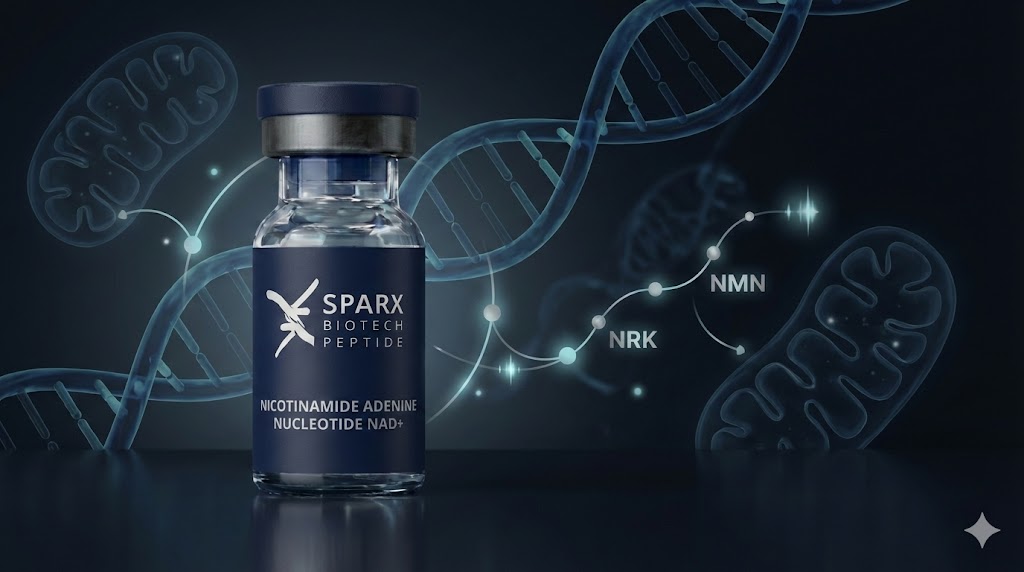
In the salvage pathway, Nicotinamide Riboside serves as a unique precursor. Unlike Nicotinamide (NAM), which requires the rate-limiting enzyme NAMPT to convert to Nicotinamide Mononucleotide (NMN), NR utilizes a distinct entry point:
- Phosphorylation via NRK: Nicotinamide Riboside is phosphorylated by Nicotinamide Riboside Kinases (NRK1 and NRK2) to produce NMN.
- Conversion to NAD+: NMN is subsequently adenylylated by NMN adenylyltransferases (NMNATs) to form the final NAD+ molecule.
Research suggests that the expression of NRK enzymes in the brain allows neurons to utilize NR effectively, potentially bypassing bottlenecks in the NAMPT pathway that may occur under conditions of metabolic stress or aging.
The Role of NRK Isoforms in Neural Tissue
Gene expression studies in murine models have indicated differential expression of NRK isoforms. NRK1 is ubiquitously expressed, while NRK2 is often upregulated in skeletal muscle and cardiac tissue. However, investigation into neuronal tissues suggests that upregulation of the NRK pathway may be a compensatory mechanism when the primary salvage pathway is compromised. This makes the specific kinetics of Nicotinamide Riboside NAD+ synthesis a subject of high interest for researchers studying metabolic flux.
Nicotinamide Riboside and Mitochondrial Function in Neurons
The relationship between cytosolic NAD+ synthesis and mitochondrial function is a focal point of neurobiology. Neurons are post-mitotic cells that cannot dilute accumulated damage through cell division, making mitochondrial health paramount. For related research on mitochondrial peptides, see our analysis of MOTS-c and Mitochondrial Metabolism.
NAD+ is essential for the function of the electron transport chain (ETC) and the citric acid cycle (Krebs cycle). Preclinical studies utilizing cell cultures have observed that enhancing NAD+ availability via NR supplementation can influence mitochondrial respiration rates.
Oxidative Stress and the NADH/NAD+ Ratio
A critical aspect of neuronal health is the maintenance of an optimal NADH/NAD+ ratio. An accumulation of NADH relative to NAD+ can inhibit sirtuin activity and impair metabolic efficiency. Research indicates that by driving the pool of available NAD+, NR may assist in normalizing this ratio in experimental models of oxidative stress. This mechanism is currently being investigated to understand how neurons manage reactive oxygen species (ROS) generated during periods of high activity.
Research Mechanisms: Sirtuins and DNA Repair
The utility of increasing intracellular NAD+ extends beyond simple energy production. NAD+ acts as a substrate for several key families of signaling enzymes. In the context of neuroprotective mechanisms of NAD+, two families are particularly prominent in research literature: Sirtuins and PARPs.
Sirtuin Activation (SIRT1 and SIRT3)
Sirtuins are NAD+-dependent deacetylases involved in regulating cellular homeostasis.
- SIRT1 is primarily nuclear and has been studied for its role in gene regulation and synaptic plasticity.
- SIRT3 is mitochondrial and is investigated for its ability to deacetylate metabolic enzymes, thereby enhancing mitochondrial function.
In laboratory settings, increasing NAD+ levels via NR has been correlated with increased activation of these sirtuins. Researchers hypothesize that this activation pathway links metabolic status to adaptive cellular responses, such as autophagy and mitochondrial biogenesis.
PARPs and DNA Integrity
Poly (ADP-ribose) polymerases (PARPs) are enzymes that detect DNA strand breaks and initiate repair. However, PARP activation consumes significant amounts of NAD+. In models of excitotoxicity or genotoxic stress, hyperactivation of PARP-1 can deplete cellular NAD+ pools, leading to energetic crisis and cell death. Preclinical research explores whether supplementing the salvage pathway with NR can replenish NAD+ stocks rapidly enough to sustain PARP function without compromising cellular viability. Similar repair mechanisms are explored in our article on BPC-157 in Tissue Repair Models.
Investigating NAD+ Decline in Aging and Neurodegeneration
Scientific literature widely documents that NAD+ levels in the brain decrease with age. This decline is associated with mitochondrial dysfunction and impaired cellular repair mechanisms. Consequently, Nicotinamide Riboside NAD+ synthesis has become a primary target for investigating the etiology of age-related cellular decline.
Axonal Degeneration Studies
One specific area of interest is Wallerian degeneration—the process of axonal breakdown following injury. Studies on the "WldS" mouse mutant have revealed that maintained NMNAT activity (and thus NAD+ synthesis) is crucial for axonal preservation. Current research aims to determine if exogenous precursors like NR can mimic these protective effects in in vitro models of axonal injury.
Preclinical Models of Protein Aggregation
In research involving transgenic models of amyloid and tau pathology, scientists are investigating how metabolic precursors influence proteostasis. The hypothesis currently under investigation is whether restored bioenergetics can empower cellular clearance mechanisms, such as the ubiquitin-proteasome system and autophagy, to manage misfolded proteins more effectively. This touches on regeneration concepts similar to those found in our article on GHK-Cu tissue regeneration studies.
Conclusion
The study of Nicotinamide Riboside and NAD+ synthesis in neurons represents a frontier in cellular biology and bioenergetics. By tracing the pathways of NRK activation, mitochondrial respiration, and sirtuin-mediated signaling, researchers are beginning to map the complex network that sustains neuronal life.
For the biotechnology community, Nicotinamide Riboside serves as a valuable chemical probe and research tool. It allows for the precise manipulation of the NAD+ metabolome, enabling detailed investigation into the fundamental mechanisms of neuronal resilience, aging, and metabolic regulation.
As data continues to emerge from preclinical trials and in vitro studies, the role of the salvage pathway in maintaining the delicate energy balance of the brain remains a critical area of scientific inquiry.