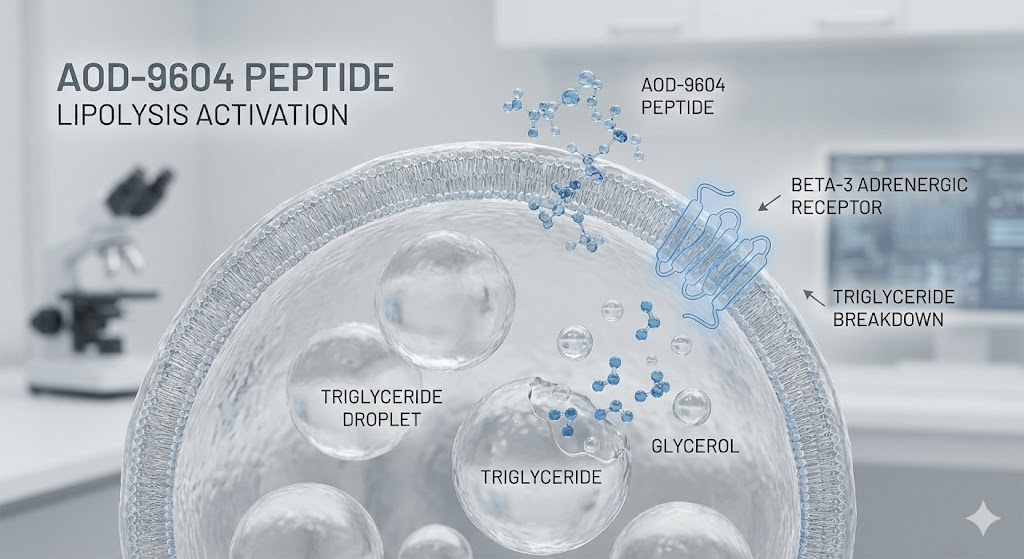
AOD-9604 is a modified, synthetic peptide fragment derived from the C-terminal region of human growth hormone (hGH). Biochemically identified as Tyr-hGH Frag 177-191, this peptide has been the subject of extensive investigation regarding its potential role in lipid metabolism regulation.
Research indicates that AOD-9604 may retain the lipolytic (fat-breaking) characteristics of hGH without inducing the pleiotropic effects associated with the full-length hormone, such as insulin-like growth factor 1 (IGF-1) secretion or hyperglycemia. As a result, it is a primary compound of interest in studies focusing on obesity, metabolic syndrome, and adipose tissue physiology.
SPARX BIOTECH PEPTIDE provides the following technical analysis for researchers exploring the signaling pathways and biochemical properties of AOD-9604.
The Biochemistry of AOD-9604
AOD-9604 is a hexadecapeptide (16 amino acids) with the sequence Tyr-Leu-Arg-Ile-Val-Gln-Cys-Arg-Ser-Val-Glu-Gly-Ser-Cys-Gly-Phe.
Its structure is distinguished by two key modifications compared to the native hGH 177-191 sequence:
- N-Terminal Tyrosine: An added tyrosine residue at the N-terminus enhances peptide stability and resistance to enzymatic degradation.
- Disulfide Bridge: A cyclic structure is formed via a disulfide bond between cysteine residues at positions 7 and 14 (mimicking positions 182 and 189 in the native hGH molecule). This cyclization is critical for maintaining the conformational integrity required for bioactivity.
This precise structural configuration allows the peptide to mimic the lipolytic domain of hGH, a region historically identified as being responsible for lipid mobilization.
Mechanisms of Action in Lipolysis Activation
The primary area of research surrounding AOD-9604 is its influence on lipolysis—the metabolic pathway through which triacylglycerols (TAGs) are hydrolyzed into glycerol and free fatty acids (FFAs). Current literature suggests AOD-9604 activates this process through distinct, non-genomic signaling cascades.
1. Upregulation of Beta-3 Adrenergic Receptors
One of the most significant proposed mechanisms is the modulation of Beta-3 Adrenergic Receptors (β3-AR). These receptors are highly expressed in adipose tissue and are fundamental drivers of lipolysis and thermogenesis.
In models utilizing obese mice (e.g., ob/ob strains), expression of β3-AR is typically repressed. Research has observed that administration of AOD-9604 correlates with a restoration of β3-AR mRNA levels to those seen in lean phenotypes.
Key Distinction: Studies suggest that AOD-9604 does not bind directly to the β3-AR as an agonist. Instead, it appears to enhance the receptor's expression or sensitivity. In β3-AR knockout models, the chronic weight-reduction effects of AOD-9604 were attenuated, suggesting that the presence of functional β3-AR is necessary for its long-term lipolytic efficacy.
2. Inhibition of Lipogenesis
Beyond stimulating the breakdown of existing lipids, AOD-9604 has been investigated for its ability to inhibit lipogenesis (the formation of new fat).
In vitro studies on adipocytes have shown that exposure to hGH fragments can inhibit the uptake of glucose into adipose tissue and reduce the activity of key lipogenic enzymes, such as acetyl-CoA carboxylase. This dual-action mechanism—promoting catabolism (breakdown) while inhibiting anabolism (buildup)—is a central theme in AOD-9604 metabolic research.
3. Independence from the cAMP Pathway
Classic lipolytic agents (like isoproterenol) typically function by elevating intracellular cyclic AMP (cAMP). However, early research indicates that the lipolytic action of hGH fragments like AOD-9604 may be independent of cAMP accumulation, pointing to alternative signal transduction pathways that regulate hormone-sensitive lipase (HSL) activity.
Comparative Research: AOD-9604 vs. Intact hGH
A critical differentiation in peptide research is the functional gap between AOD-9604 and full-length human growth hormone (191 amino acids). While intact hGH is a potent lipolytic agent, its use in research is complicated by its broad spectrum of activity.
| Feature | Intact hGH (191 AA) | AOD-9604 (16 AA) |
|---|---|---|
| Primary Receptor | hGH Receptor (GHR) | Unidentified / Non-GHR |
| IGF-1 Secretion | High stimulation | No observed stimulation |
| Insulin Sensitivity | Can induce resistance | No negative impact observed |
| Lipolytic Potency | High | High (Specific to adipose) |
The IGF-1 Factor:
The most significant finding in comparative studies is that AOD-9604 does not stimulate the liver to secrete IGF-1. Intact hGH exerts many of its anabolic effects (muscle growth, organ growth) via the IGF-1 axis. By bypassing this axis, AOD-9604 allows researchers to isolate metabolic and lipolytic variables without the confounding variables of systemic growth signaling or insulin resistance.
Potential Applications in Research Models
Given its specific mechanism of action, AOD-9604 is a standard reference standard in several areas of biotechnology and physiology research.
1. Obesity and Metabolic Syndrome Models
AOD-9604 is frequently utilized in rodent models (such as Zucker fatty rats and C57BL/6J mice) to study the reduction of visceral and subcutaneous adipose tissue. Researchers measure endpoints such as:
- Changes in fat mass vs. lean muscle mass.
- Plasma glycerol and free fatty acid levels (markers of lipolysis).
- Adipocyte size and differentiation status.
2. Cartilage and Tissue Repair
While primarily known for metabolic research, secondary studies have explored AOD-9604 in the context of chondrocyte (cartilage cell) proliferation. In vitro evidence suggests the peptide may enhance the production of collagen and proteoglycans, potentially offering insights into tissue regeneration pathways distinct from direct hGH action.
Conclusion
AOD-9604 represents a targeted tool for the investigation of adipose tissue physiology. By isolating the lipolytic C-terminal domain of human growth hormone, it offers a unique profile that activates fat metabolism pathways—specifically through β3-AR upregulation and lipogenesis inhibition—without engaging the IGF-1 axis. This specificity makes it an essential compound for researchers aiming to understand the molecular basis of obesity and metabolic regulation.